Silent Epidemic: Why So Many Men Suffer in Secret and What Real Healing Could Look Like
written by Gonçalo Luz
Across much of the world, a quiet tragedy unfolds. Men - fathers, brothers, husbands, leaders, creators, teachers, everyday working men, are carrying invisible burdens that few around them truly see. They hold pressure within. They hide fear behind competence. They mask loneliness with productivity. They bury anxiety under responsibility. And no one, or almost no one knows.
We don’t often hear the stories. We see the outcomes. The man who was “always smiling,” suddenly gone, the father who collapses under silent pressure, the friend who “didn’t seem the type” to be depressed, the colleague who withdraws more each year until he disappears into work, substances, or hopelessness. Despite decades of mental-health awareness campaigns, the truth is unavoidable: Most men who suffer emotionally are still suffering in silence.
This article explores the why, using the latest research from 2024-2025, and offers a compassionate, grounded look at what real healing can look like: through connection, through brotherhood, through men’s circles, through retreats, and through pathways that finally give men space to breathe.
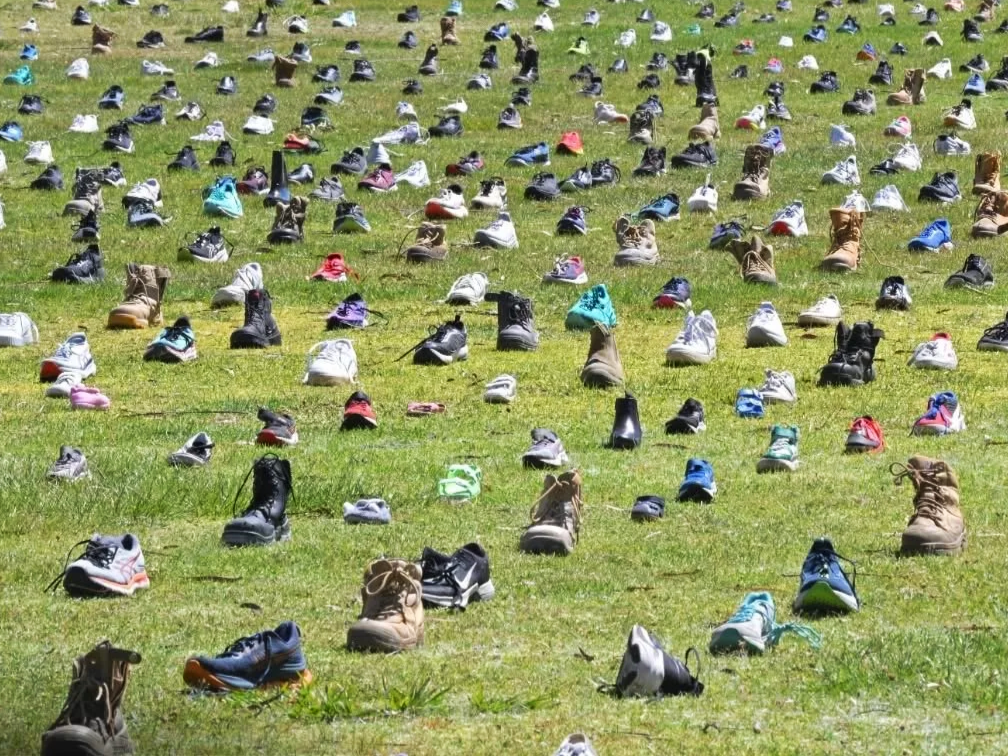
2,500 empty pairs of shoes laid outside Australia’s Parliament House by Zero Suicide Awareness organization, remind us that men are dying in silence. Photo: AAP/Mick Tsikas
The Scale of the Crisis: What the Data Shows
Before we talk about healing, we have to face a difficult truth: men are struggling at unprecedented levels. And the data is no longer subtle. It is overwhelming. Across the UK, United States, Europe, Australia, and much of the world, men account for roughly 75-80% of all suicide deaths. This is not a marginal difference. It is a profound and persistent gap. In the UK, men are around three times more likely to die by suicide than women. In the US, nearly four out of every five suicide deaths are male. Scandinavian countries often praised for social support systems and equality, show similarly disproportionate rates. These numbers are not indicators of weakness or moral failure. They are indicators of deep, unresolved suffering that is rarely spoken about.
Beneath suicide statistics lies a broader, quieter crisis. Recent studies from 2024-2025 suggest that around one in eight men meets criteria for major depressive disorder at any given time, while a much larger group, close to one in five, experiences significant depressive symptoms without ever receiving a diagnosis. Loneliness has become one of the most consistent and powerful predictors of male distress. Up to 30% of men, particularly between the ages of 30 and 55, report chronic loneliness-often while appearing functional, productive, and “fine” from the outside.
This loneliness does not exist in isolation. It compounds with long work hours, financial pressure, the weight of the provider role, declining male friendships, and the gradual erosion of spaces where men feel safe to be honest. Many men move through life carrying the unspoken demand to remain composed, capable, and unaffected, no matter what is happening internally. Over time, that pressure creates a slow internal collapse: not dramatic, not visible, but deeply destabilizing.
Perhaps the most painful aspect of this crisis is that men rarely reach for help, even when they are suffering intensely. Across cultures and studies, men are significantly less likely to seek therapy, more likely to delay support until they reach a breaking point, and more inclined to hide symptoms from partners, friends, and family. Emotional pain is often accompanied by shame. Self-reliance is prized even when it is clearly failing. For many men, help-seeking itself feels like a violation of the masculine code they were raised with.
Men report high rates of:
Workplace burnout
Chronic stress
Social disconnection
Lack of close friendships
Emotional numbness
Irritability, anger, or emotional shutdown
Yet, these symptoms often remain unlabelled, experienced as personal failure, not as treatable conditions. The truth is that men rarely seek help, even when suffering. This may be the most concerning pattern of all.
Despite high levels of emotional pain, studies show that men:
Are far less likely than women to seek therapy
Delay seeking help until problems reach a breaking point
Often fear being judged, shamed, or seen as “weak”
Prefer to “handle things themselves”
Report not knowing where to find male-friendly emotional support
This is where the real crisis lives, not only in the numbers, but in what happens beneath them. To understand why so many men suffer in silence, we need to look deeper than symptoms and statistics. We need to examine the structures, expectations, and beliefs that keep men isolated even when support exists.

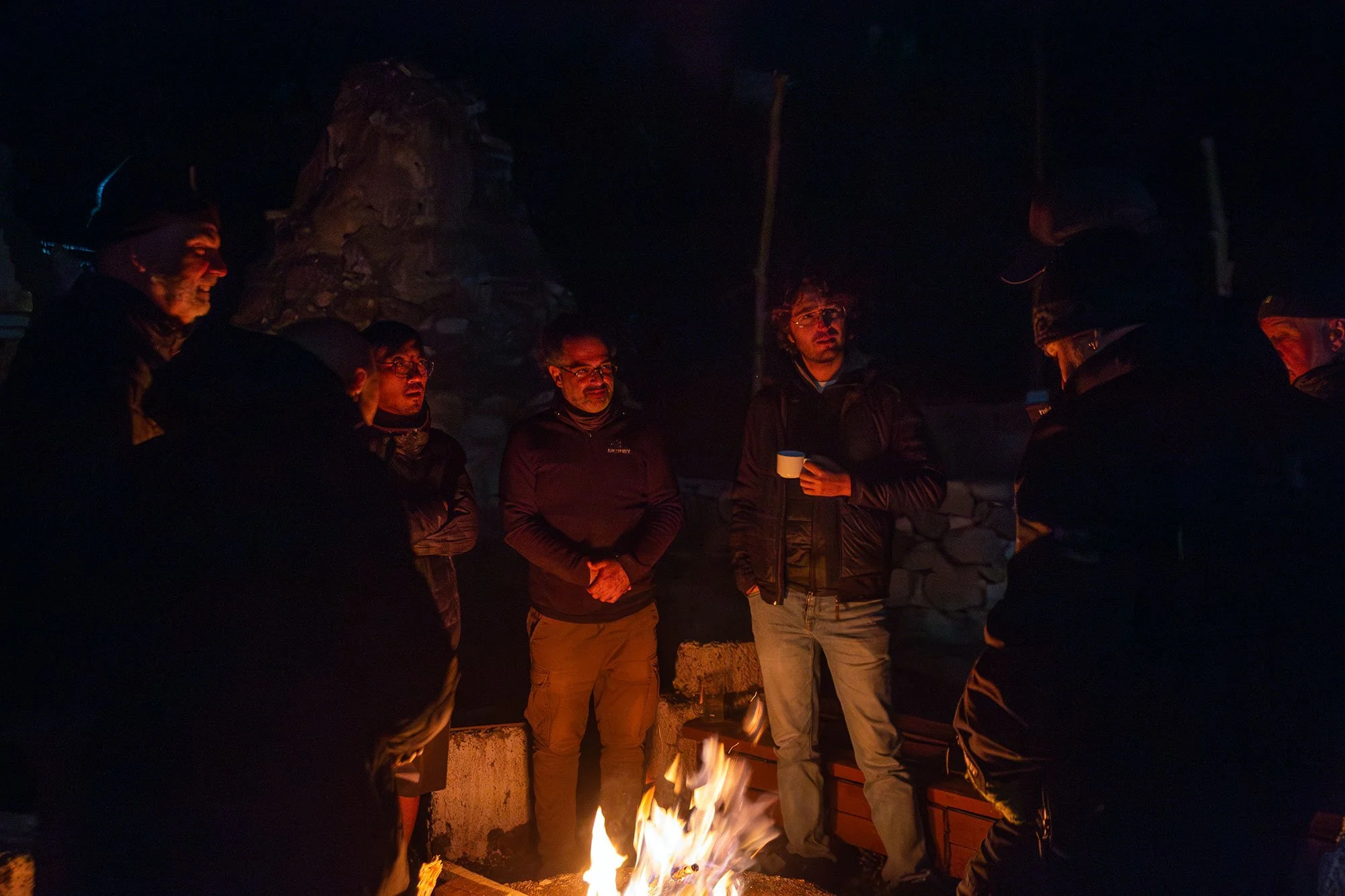
Group of men gathered in a men’s retreat
Why So Many Men Suffer: The Hidden Barriers
Male suffering is rarely just personal. It is cultural, it’s societal, it’s generational. Men are not born silent, they are taught to be. From early childhood, many boys internalize the same unspoken rules: don’t cry, don’t show fear, don’t ask for help, don’t be a burden. These messages don’t remove emotion, they train men to conceal it, often at great cost.
Traditional Masculinity Norms: The Unspoken Script
Research consistently shows that the stronger a man’s identification with rigid, traditional masculinity norms, the harder it becomes for him to express emotion or seek support. This is not a critique of masculinity itself, but of outdated and inflexible versions of it. The traditional unspoken script equates strength with suppression, independence with isolation, leadership with silence, and resilience with emotional numbness. While these traits may have once served survival, they often become traps in modern emotional and relational life.
What Men Tell Researchers
When men are asked why they delayed seeking help, their responses are remarkably consistent. Many say they didn’t want to burden others, believed the pain would pass if they pushed through, or simply didn’t know how to talk about what they were feeling. Others feared appearing weak or worried they would be seen differently by their partner or family. These are not excuses, they are learned survival strategies passed down across generations.
Shame, Stigma, and Emotional Literacy Gaps
Many men carry the quiet belief that if they feel this way, something must be wrong with them. Because emotional literacy is rarely taught, men often struggle to name what they’re experiencing or understand its source. Depression and anxiety are frequently misinterpreted as irritability, anger, numbness, restlessness, or burnout. Without the language or framework to recognize these states, men often ignore them until they reach a breaking point.
Isolation and the Collapse of Male Friendship
Men’s friendships tend to decline sharply after the age of 30. By midlife, many men have few close relationships where honesty feels safe. This isolation is not only emotionally painful, it is physiologically harmful. Chronic loneliness increases stress hormones, disrupts sleep, impairs decision-making, and contributes to long-term health risks. Modern life has stripped many men of the brotherhood and shared spaces that once provided belonging and stability.
When Therapy Feels Like the Wrong Doorway
Therapy can be life-saving and is essential during acute crisis, severe depression, trauma, or suicidal ideation. At the same time, many men struggle to connect with traditional therapeutic settings. Talking about feelings in a clinical environment, or being asked to articulate emotions they were never taught to name, can feel alien or shame-activating. Research suggests many men engage more readily through structured, goal-oriented, peer-based, or embodied approaches. The issue is not therapy itself, but access. Men need multiple doorways into healing, not a single model that assumes everyone relates to emotion in the same way.
What Real Healing Could Look Like: A New Vision for Men’s Mental Health
Men don’t need to be fixed. They need forms of healing that meet them where they actually are, not where mental-health systems assume they should be. Research and lived experience increasingly point to approaches that honor how men process emotion, stress, and connection. When healing is relational, embodied, and practical, men engage and real change becomes possible.
Men’s Circles: A Return to Brotherhood
When men gather in a men’s circle with clear intention and mutual respect, something fundamental shifts. The performance drops. Defenses soften. The nervous system settles. In these spaces, men experience conditions that are rare in modern life: non-judgment, shared vulnerability, accountability, emotional witnessing, and genuine connection.
In men’s circles, men recognize themselves in one another. They see that their struggles are not personal failures, but shared human experiences. This recognition alone can be deeply regulating. Over time, men learn that vulnerability is not weakness, it is courage and emotional maturity. For many, this is the first time they feel truly seen, and often a turning point in their healing journey.
Men’s Retreats: Space to Reset, Reflect, and Rebuild
Men’s Retreats work because they remove men from the environments where burnout, avoidance, and numbing behaviors are reinforced. Stepping away from routine creates perspective. Entering a structured, safe container, often in nature, allows men to slow down enough to feel what has been pushed aside.
Men’s retreats typically combine embodied practices, yoga, meditation, emotional exploration, physical challenge, journaling, ritual, and time outdoors. This combination engages both body and mind, creating conditions for insight and integration. For many men, retreats function as a form of initiation, an experience of challenge, reflection, and brotherhood that modern life rarely provides.
Embodiment and Somatic Work: Healing Beyond Words
Talk therapy can be powerful, but for many men, the body is the gateway. Stress, trauma, and suppressed emotion are often held somatically as a tight chest, clenched jaw, shallow breath, chronic tension, restlessness, or emotional numbness. These are not abstract experiences; they are physiological states. Embodied practices ranging from Hatha Yoga to Somatic Therapy help men reconnect with their bodies, regulate the nervous system, release stored tension, and rebuild emotional capacity. This is not “woo-woo.” It is grounded in neurophysiology. When the body feels safe, emotions can move. When emotions move, clarity and resilience follow.
Online Men’s Work and Courses: Accessible Gateways
Not every man can step away for a retreat or enter a group immediately. Online men’s work offers an accessible starting point. Self-paced courses allow men to begin privately, learn foundational tools, build awareness, and take first steps without pressure or exposure. For many men, this creates momentum. What begins as quiet exploration often leads to greater openness, confidence, and readiness for deeper connection. In a world where isolation is common, accessible entry points into self-work matter.
From Silence to Solidarity: A New Path Forward
The truth is this that men are not broken, they are not failing, they are not weak. They are carrying unbearable pressures alone, in a world that taught them not to speak. Men don’t need to be fixed, they need to be supported. They need spaces, tools, brotherhood and pathways that honor who they are, not who society told them or wanted them to be. The mental-health crisis among men is not inevitable: It is preventable, it is reversible, it is healable. When men gather, share, breathe, move, heal, and reconnect, extraordinary things happen. Men become whole, grounded, men become capable of leading with clarity and heart. They remember themselves.
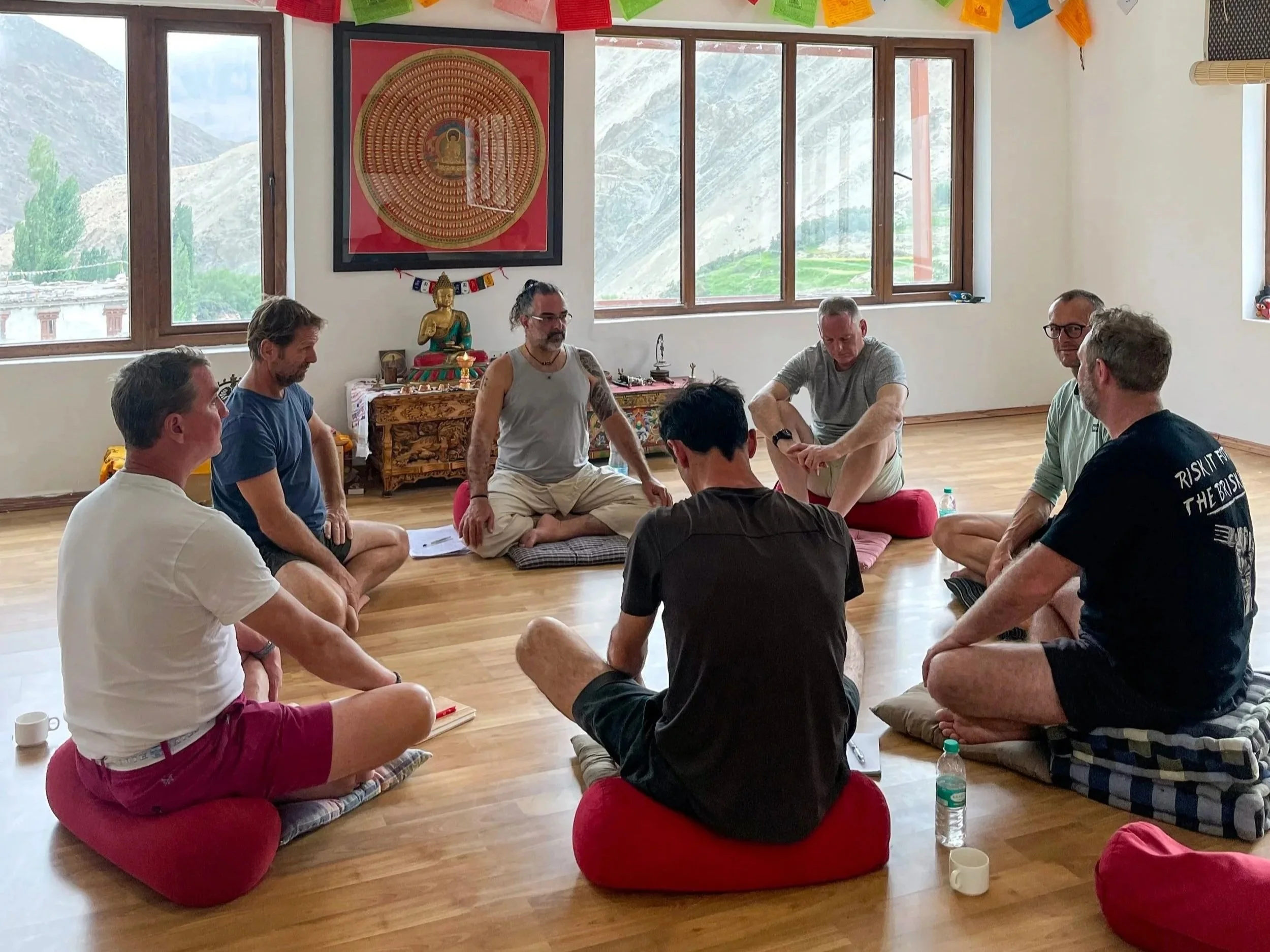
Men’s group in a men’s circle
A Gentle Invitation
If you’re reading this and something inside you softened or tightened, you are not alone. If you’ve been holding too much for too long, you’re not alone. If you’ve been feeling lost, numb, overwhelmed or disconnected, you’re not alone. There are places where men gather, where men breathe, where men speak the truth, where men heal, where they rewild their masculinity, wher men remember who they are.
At Inner Outer Journeys, we create exactly these spaces, through:
Men’s circles and Men’s Work seminars in Thailand, at Sacred Grounds CNX in Chiang Mai
Online courses through Rewilding Masculinity
You’re invited to step into a circle, into a journey, into your own presence again. Not because you are broken, but because you deserve to feel supported, grounded, connected, and alive.

References
Suicide, Depression & Men’s Mental Health Data
Mental Health Foundation UK (2024). Men and Mental Health Statistics.
https://www.mentalhealth.org.uk/explore-mental-health/statistics/men-women-statisticsHeadsUpGuys (2024). Suicide in Men: Key Statistics.
https://headsupguys.org/suicide-in-men/suicide-stats-men/World Health Organization. Suicide Worldwide Data.
https://www.who.intDziedzic, B. et al. (2025). Depression, Anxiety and Loneliness Among Men in Poland. Frontiers in Public Health.
https://www.frontiersin.org/journals/public-health/articles/10.3389/fpubh.2025.1539822/full
Traditional Masculinity & Help-Seeking Behavior
Mokhwelepa, L.W. et al. (2025). Traditional Masculinity Norms and Men's Willingness to Seek Help.
https://pmc.ncbi.nlm.nih.gov/articles/PMC12117241/Galvez-Sánchez, C.M. et al. (2024). Masculinity and Male Suicide Risk.
https://www.mdpi.com/2673-5318/6/1/2Wagner, A.J.M. et al. (2024). Depressiveness, Loneliness & Non-Disclosure in Men.
https://www.sciencedirect.com/science/article/pii/S266656032400001X
Barriers to Therapy & Help-Seeking
Lok, R.H.T. et al. (2025). Barriers to Mental-Health Engagement Among Men in Developed Countries.
https://www.sciencedirect.com/science/article/pii/S2667321525000745Sheikh, A. et al. (2024). Why Young Men Don’t Seek Help for Affective Disorders.
https://pmc.ncbi.nlm.nih.gov/articles/PMC11868194/AAMC News (2024). Men and Mental Health: What Are We Missing?
https://www.aamc.org/news/men-and-mental-health-what-are-we-missingBMC Psychology (2025). Help-Seeking Among Korean Men: Masculinity, Loss of Face and Self-Stigma.
https://bmcpsychology.biomedcentral.com/articles/10.1186/s40359-025-02793-yStaiger, T. et al. (2020). Masculinity and Help-Seeking Among Men With Depression (MenDe Study). https://www.researchgate.net/publication/346698096